|
 |
|
|
|
 |
|
The legend of the Dodge Viper began when the Viper was originally produced in 1989, as a concept car that was introduced to both the public and media at the international auto show in Detroit. The Viper immediately appealed to the public and received great reviews that developed a strong desire for a production model.
Dodge Viper was launched into the arena of fast action in 1991; as the pace car for the Indianapolis 500 with Carroll Shelby as pace car driver.
The first model available for purchase to the public was the 1992 Dodge Viper RT-10 and during the first year of production all Vipers were painted Viper red with only 285 cars being manufactured in total.
The Dodge Viper has the largest factory production performance engine being manufactured in the world today at 8.4 Liters/510 cid. The V10 Viper engine is also one of the most powerful high performance engines ever created for a production sports car.
|
 |
 |
|
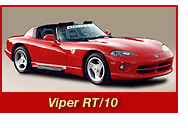 The Dodge Viper RT10 Roadster is the original Viper that started the excitement about a new american sports car.
The RT/10 continued to evolve and develop more power with better performance, initially starting with 400 hp and then moving up to 415 hp with the 1996 model, ultimately increasing to 450 hp in 1997.
The Viper RT/10 proved to be an extremely unique sports car that commanded a lot of respect by delivering a lot of high performance.
There are now four different Viper production car models and three generations of the Dodge Viper. The original 1st Generation Viper RT/10 was produced from 1992 to 1996 and then redeveloped as a 2nd Generation Viper in 1997.
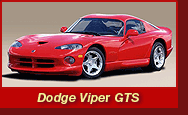 |
The Viper GTS was introduced in 1996 as the 2nd generation Viper and the first Viper hardtop coupe.
The weight was reduced by 200lbs from the 1st Generation RT/10 and the chassis was more rigid.
|
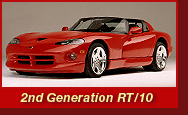 |
The 2nd Generation RT/10 debut in
1997, one year after the release of the GTS.
The 2nd Generation RT/10 and the GTS Coupe are mechanically similar with different body panels and roof structures that were in production until 2002.
|
 |
The 3rd Generation Viper was released in 2003 as the Viper SRT 10 Convertible model.
The SRT 10 offers more power and better performance in a lighter car.
|
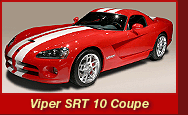 |
The 2006 SRT 10 Coupe is the latest model
providing a more rigid structure and better
aerodynamics than the convertible.
The Viper Coupe continues the 500/500/500 tradition with 505 cid producing 500 hp and 525 lb-ft torque.
|
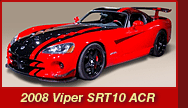 |
The 2008 Viper SRT10 ACR is a street legal factory race car and the most technologically advanced and powerful production Viper ever developed.
The new 8.4 Liter (510 cid) V10 Viper engine produces 600 hp and 560 ft. lbs. torque.
|
|
|
|
|
|
|
 |
|
|
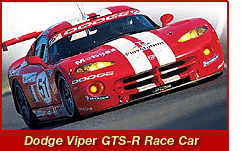 Chrysler introduced the Dodge Viper GTS-R in 1995, as a limited-production race car for worldwide GT-class competition.
The standard engine was a 525-horsepower 8.0 liter V-10, with 650 and 750-horsepower engine options being available.
Chrysler introduced the Dodge Viper GTS-R in 1995, as a limited-production race car for worldwide GT-class competition.
The standard engine was a 525-horsepower 8.0 liter V-10, with 650 and 750-horsepower engine options being available.
The GTS-R is a Limited Edition race version of the Dodge Viper GTS and is not street legal.
The Viper GTS-R was created in response to requests for a racing version of the GTS Coupe, consequently Viper race
cars are designated as GTS-R models with several versions of GTS-R race cars being produced for
competition.
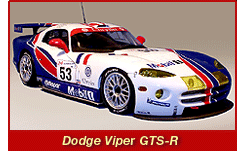 The Viper GTS-R successfully entered the world of race competition and won the drivers’ and manufacturers’ world
championships and effectively competed against many European sports cars such as Porsche and Ferrari.
The Viper GTS-R successfully entered the world of race competition and won the drivers’ and manufacturers’ world
championships and effectively competed against many European sports cars such as Porsche and Ferrari.
The GTS-R also won the 1997 FIA GT2 championship and the 1998 24 Hours of Le Mans in the GT2 Class.
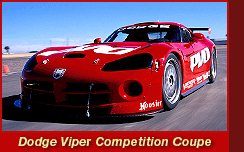 The Dodge Viper Competition Coupe is a limited production racing vehicle available from Dodge to professional and semi-professional drivers with racing credentials.
The Competition Coupe is the race car version of the Viper SRT-10 and the latest racing Viper from Dodge that replaces the Championship winning Viper GTS-R.
|
|
|
|
|
|
 |
|
|
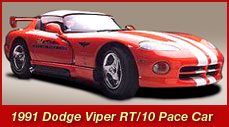 The Dodge Viper was selected as pace car for the 75th annual Indy 500 race on May 26, 1991.
The 1991 Indy 500 provided a dramatic introduction for this new
car since the Viper was not
scheduled to be in dealer
showrooms until 1992. The Viper successfully performed pace car duties
with V-10 engine power and Carroll Shelby doing the honours
as pace car driver.
|
|
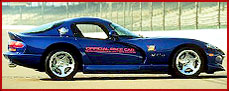
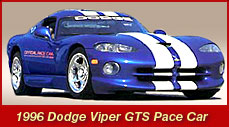 The Dodge Viper returned to Indianapolis on May 26, 1996, as the pace car for the 80th Indy 500 race. The 1996
Viper pace car was the new GTS coupe which was driven by Chrysler president Robert Lutz.
The Dodge Viper returned to Indianapolis on May 26, 1996, as the pace car for the 80th Indy 500 race. The 1996
Viper pace car was the new GTS coupe which was driven by Chrysler president Robert Lutz.
|
|
|
|
|
|
|
|
|
Ned Erkman
Author of The Read for Viper Speed
|
|
Intro
| 1992-1996
| 1997-2002
| 2003-2006
| 2006
| Engines
| Performance
|
|
|